infolinks

Showing posts with label Bursamalaysia. Show all posts

Saturday, December 26, 2015

Investment ; Bye-bye 2015 and hello 2016

To many investors 2015 can be regarded as a  very difficult year. Even in a difficult year like 2015 there are investors who are able to grow their wealth investing just in Bursamalaysia. Mr. Koon Yew Yin is one the shrewd and experienced investors able do just that. Below is his ideas on how to approach the local stockmarket to stay on the safe side. Hope that the readers here will find the piece below helpful.

==============================================

How can investors make money in 2016? Koon Yew Yin

Author: Koon Yew Yin   |   Publish date: Sat, 26 Dec 2015, 09:06 AM 

Many people have asked me this question. In the last 2 festive days, many people told me how I have changed their lives through my charity work and my writing on Malaysian politics and share investment.
One commentator of my recent article said that 99% of the readers like my writing and only 1% do not like. As a writer, I expect some critics and I expect them to do it in a polite manner and not like illiterates or idiots.    
Here are some of holdings which still comply with my share selection golden rule even after their prices have gone up quite rapidly.  My golden rule is that I must be sure that the company can make more profit this year than last year and the projected P/E ratio is not more than 10.
I advise you to check all the shares you are holding to see that they can comply with my golden rule. Otherwise, you must cut loss and utilize the proceeds to buy better shares.  
Can One: It is the largest tin cans and jerry cans manufacturer. It started more than 40 years ago and continues to improve its operation. It bought 146.1 million or 32.9% of Kian Joo shares at Rm 1.65 per share in 2012. The current price of Kian Joo is about Rm 3.30 per share. EPF is one of the 2 parties who have made an offer to buy up Kian Joo. Can One is waiting patiently.
Its 3 quarter EPS ending Sept 2015 was 39 sen and I can safely project its full year EPS to be about 55 because some of its products are sold in US$. Its last closing price was Rm 4.50. It will announce its full year result before end of February 2016.
Chin Well: It is among the largest manufacturers of screws, nuts and bolts in the world. 76% of its products are exported in foreign currencies. After it has acquired the 40% shares from its Vietnamese partners, its latest quarter EPS jumped to 6.07 sen from 4.41 sen. Its last closing price was Rm 1.92 per share.
Thong Guan: It is one of the largest plastic stretch film and bags, raffia stings, drinking straws and paper serviette manufacturers in the Asians region. It started business in 1942.
Its 1st, 2nd and 3rd quarter EPS are 4.4, 6.75 and 10.7 sen respectively. It about 2 months it will have to announce its 4th quarter result. In view of the depressed fossil fuel price, its raw plastic materiel is getting cheaper.  What will be its share price when its annual result is announced before end of Feb 2016?     
I am also holding VS, Latitude, Lii Hen, Focus Lumber and Ge Shen because they still comply with my golden rule although their share prices have gone up quite rapidly. 
I am not asking you to buy any of the shares I mentioned above. But if you buy, you are doing it at your own risk.

Above is re-posted from the link below:-

http://klse.i3investor.com/blogs/koonyewyinblog/


Monday, October 20, 2014

Mark Mobius: Pick stocks on dividend yield


Mark Mobius, Chairman of  Franklin Templeton has some insight into investing in Bursamalaysia. I am pasting his comments below for my reference and freely share others:-

"Investing in stocks that pay good dividends is the best strategy for investors in the short term as the FBM KLCI is overvalued in price-earnings ratio (PER) terms compared with other Asian indices, said Templeton Emerging Markets group executive chairman Dr Mark Mobius.
Yesterday, the KLCI closed at 1,803.14 points, with a PER of 16.38 times. On the other hand, Singapore’s Straits Times Index ended the day with a PER of 13.27 times while the Hang Seng Index closed with a PER of 10.05 times.
“It’s not a good idea to make short-term decisions in the market. Look at individual stocks in Malaysia to determine what the growth rates are going to be and what the valuations are now. At this stage, there are a number of stocks that you can buy, but I wouldn’t rush in.
“You have to look for cheaper stocks, those that have good growth but a relatively low PER and [good] yields. At this stage there are a number of very attractive high-yielding stocks, where the yields range from 5% to 7%,” Mobius told reporters after a luncheon talk yesterday.
He said stocks such as British American Tobacco (M) Bhd ( Financial Dashboard), Guinness Anchor Bhd (Financial Dashboard), Carlsberg Brewery (M) Bhd ( Financial Dashboard) and banking stocks are of particular interest, as those traditionally reward shareholders well.
“I’m very interested in banks, in particular. Because they reflect the growth of the country they are in. They [are] more diversified and less volatile as a result, and you get a nice dividend yield,” Mobius said.
He is also interested in the pharmaceutical and medical care industries as they are “high-growth industries”, while he considers the property sector in  Malaysia as one of the best markets for foreign investment.
“Property companies here look quite interesting, particularly those that are in a diversified portfolio,” Mobius said.
In his presentation earlier, Mobius said while property prices in Malaysia are rising, the number of non-performing loans and mortgages is declining, demonstrating the buying ability of Malaysians compared with other countries in the region.
“Thailand, Indonesia and [the] Philippines have a higher rate of non-performing loans. So from that point of view, it’s (Malaysian property) clearly affordable and if you look at house prices in relation to income, Malaysia is right there at the bottom,” he said.
On Malaysia as an investment destination, Mobius said tax rates for investors and predictability are the determining factors for foreign direct investments (FDIs).
“One of the things that hurt Malaysia a lot during the Asian financial crisis was when it stopped money going out. That created a lot of angst among foreign investors. It is very important to create a sense of confidence that there will be some predictability in the rule of law,” he said.
However, Mobius said factors like the undervalued ringgit, high-yielding stocks, the government’s programme to open up the market and efforts to integrate with other Asean markets also contribute to attracting FDIs.
On how the KLCI would end the year, he said the index should close higher — barring major crises — but did not specify a target.
“The trend is definitely moving upwards despite the valuations because there is room to accommodate high PER since the interest rates are so low,” he added."

This article first appeared in The Edge Financial Daily, on October 21, 2014.

Tuesday, February 15, 2011

Petronas Chemical ====> just off the starting block


The chart above is for Petronas Chemical, which is just listed in BursaMalayisa on 26th November 2010.
This counter attracts institutional investors and has so far displayed great resilience when it is traded above the institutional IPO price of RM5.20. The weaker institutional investors would have sold off at least part of their holding and the resilience may be due to the stronger institutional investors still willing to accumulate on weakness. This counter is very liquid as it has eight (8) billion shares issued. coupled with the recent IPO there is ample free floating shares ready to find stronger hands.
From the chart above there is a possibility of a temporary double top at RM6.39 and a support at RM 5.93.
Also to be noted is that it is trading within an uptrend channel. Since it is now near the lower side of the uptrend channel and near to the support of RM5.93 it maybe good and possible to buy at below RM 6 so that a profit can be made if it goes up and away from the lower channel.It may move up to challenge the double top at RM6.39. If it fails to break through RM6.39 then it should be sold, otherwise if RM6.39 is successfully penetrated it can go higher and the wisdom is to let the profit run.

Another possibility is that it may go below the support line. If this happens a stop out will have to be executed say at RM5.80
The above is just my guess.


For those who had viewed the previous chart and read my comment may like an update. It looks very much like the double-top may be challenged soon as the price is pulling away from the lower channel support line.


Saturday, January 1, 2011

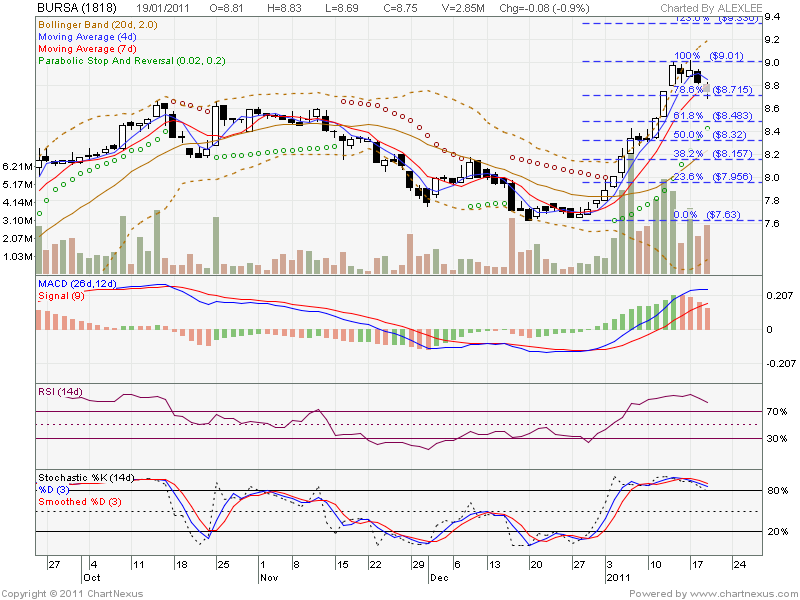
Bursa Malaysia looks like about to turn up

The chart shows that Bursa has a good chance to at least turn up in the short term fom here.
This counter is co-related to the volume of the market. As the market is having good volume lately there is a good chance for this counter to turn up at least for the short term.
The three (3) arrows shown in the MACD, RSI and Stochastic chart seem to confirm that what I observe is true. MACD is about to form the golden cross and both RSI and Stochastic are in the lower area.
So it will be a good strategy to buy on weakness from now and sell it off when it hit the resistance shown by the upper parallel line.
This Bursa chart is added on 19.1.2010. It is a holiday to commemorate Thaipusam, so I am free to look at the chart I posted on 30th December 2010.
The price of Bursa has so far performed well from the day I suggested and now has started to turn down.
In fact it pierced through the upper resistance line then only it started to consolidate.
From now on, will there be a buying opportunity? To find the answer let us look at the Fibonacci retracement.
Right now it has retraced 78.6% (@RM8.72). The next retracement is at 50% (@RM8.32) and if this break down it may retrace to 38.2% (@RM8.16)
So, my suggestion is for those who has higher risk tolerance level can start to accumulate at around RM8.32 (50% retracement) and those with lower risk tolerance level can accumulate at RM8.16 (38.2%)
This opportunity will only presents itself if the retracement reaches these levels.
Anyway, stock market is fraught with uncertainties and without uncertainty stock market will not be so complex.and challenging.

Sunday, December 26, 2010

Batu Kawan is a cheaper proxy to Kuala Kepong

Between 15th October 2010 (Friday) and 18th October 2010 (Monday) Batu Kawan formed a  gap up from 15 to 15.30 with a relatively large volume which is shown in the chart above. This is partly because on 14th October 2010 CIMB Investment Bank published a very rosy picture of Batu Kawan as a potential privatisation candidate and attach a value of 18.02 to Batu Kawan.
There on, this counter has a fair bit of fluctuations and went on to form a bear divergence. with both MACD and RSI. This bear divergence push it to a mild correction (which suggest strength) on smaller volume. 
At the moment it is traded cum dividend. The 50 sen single tier dividend will only go ex on 22nd February 2011. So there is ample opportunity to accumulate Batu Kawan now. Not only the investor will enjoy a handsome dividend but also can ride on the strength of an up trend  journey.
Another important point is, Batu Kawan holds 45.65% of issued shares of Kuala Lumpur Kepong (KLK). KLK's closing price on 24th December 2010 is 21.78. On a very conservation estimate of just taking the worth of 45.65% of KLK at 21.78, Batu Kawan is worth more than 24. 
So if anyone is thinking of investing in KLK, Batu Kawan is much cheaper proxy to investing in KLK.. 

Friday, December 24, 2010

AEON on consolidation path

I posted AEON chart on 23 December 2010, suggesting that it is about to have short term weakness . True enough, on 24 December there was a spike down from the previous close of 6.24 to 5.82 with a small volume.. It closed at 6.10 for a 19 sen loss which is equivalent to 2.9% decrease. I think that the correction of AEON is not over yet and those who wish to invest in AEON should wait for a while longer.
For those who have invested at lower level should sell on strength as you have a good chance to buy back lower.

As usual, if you use what is written above to buy or sell the risks and rewadrs are entirely yours as only the opinion is mine.  Best of luck from me.

Thursday, December 23, 2010

Take profit on AEON

AEON is at the top of  an uptrend channel.
My guess is to take profit now and buy back later.
There is a bearish divergence, which is a confirmation that it has a short term weakness.

Daiboci at turning point

Daibochi chart as at 23rd December 2010.
Currently the price is 2.55
Daibochi is at a turning point. which may presents an opportunity for traders who wish to trade short term
It has broke through the S1S2 support line and is on downtrend following D1D2.
It is about to touch D1D2 and traders can buy now to ride the correction for it to reach the upper parallel line of  D1D2.
If you are lucky to buy at this price you can look forward to sell higher for a profit.
Ultimately it should move up to slightly above RM3 level.

Thursday, December 2, 2010

Boustead has value for investors and has excitement for traders


The Boustead chart above is captured on 2nd December 2010.
Current price is about 5.50
Even at this price I think, it is still a good long term buy for investors who fancy stocks that pay attractive dividend on a regular basis. It has just declared a single tier 12 sen dividend which will go ex on 14th December 2010. This is the third dividend declared in as many quarters. First and second quarter dividends are 5 sen (single tier) and 10 sen (single tier) respectively making a total of 27 sen dividend so far. I expect Boustead will declare a final dividend in 3 months time.
Chartwise it has climbed from about 4.29 level (24 Sept 2010) to a recent peak of 6.05 (26 Oct 2010)
On 24 th November 2010 it had retraced slightly more than 50% to 5.08.
Currently it resumes its uptrend move . It should be able to go higher from here and if the 6.05 level of resistance is broken it may climb even higher

The above opinion is mine and if ever you use the info for investment or trading you need to take you own risk..


Wednesday, November 10, 2010

Oriental Food Industries may be bottom forming now


The chart above is captured from Chartnexus for Oriental Food on 10th November 2010.
There are two vertical lines showing the two peaks (higher high) showing an uptrend.
These two peaks are formed about six (6) months apart. [first peak on 13th January 2010 and the second higher peak on 23 July 2010]

Another set of Fibonacci Retracement lines are inserted to guage the current state of correction.
If we take the last upswing to start from 25th May 2010 (0% at 1.38) to 23.July 2010 (100% at 2.19) the current (10th November 2010)  Fibonacci Retracement level is about 38.2%.

My  guess is as follows:
1. Possibly the current level is the bottom building stage. However if this fails to hold the next  Fibonacci Retracement level is at 23.6% and it sits at 1.57 (price level)
2. If this bottom building take about six (6) months, the next peak may occur around January 2011.
3. So if you believe that this study is of any value, it will be profitable to accumulate at this level (~ 1.70) and sell your accumulation of this counter sometime in January 2011 at a higher level.
javascript:void(0)
Written by Lee Huong Sing

Tuesday, November 2, 2010

Take a look at AEON

The chart above is from Chartnexus taken on 2nd November 2010

The counter under review is AEON.

Malaysian Stock Market has done well this year with FBMKLCI overshooting 1500 level. With this high level it is getting more difficult to trade profitably as the risk factor gets bigger.. .
I have a look at AEON today and found that it started to trend up from 27th August 2010 starting a around 5.10 level. It went on to form a short-term double-top on 1st October 2010 and 6th October 2010 at 6.10. On 7th October 2010 a was big sell down, probably by a big investor. Since then it goes downtrend.
Checking with Fibonacci retracement at 50% the price is at 5.56. It has since pierced through and currently trading around 5.50.  The next Fibonacci retracenment of 38.2% is at 5.43.

With this analysis I believe that it is now at bottom building stage. It may be a profitable move to accumulate at this level or lower and hopefully that it turn in a profit on selling at a higher level in one or two months from now.
This is my personal view and if you trade using my view I wish you best of luck.

Lee Huong Sing

Wednesday, October 27, 2010

KSL Holdings (buy call by HLIB Research)

Strong earnings growth, grossly undervalued
§         Large landbank in Iskandar Malaysia (IDR) makes KSL poised to benefit from improving Singapore-Malaysia ties and the integrated resorts in Singapore.
§         Has one of the highest margins in the industry due to its unique business model of keeping construction works in-house, efficiently use of landbank and low land acquisition cost.
§         Under-researched company.
§         Step-up in earnings driven by new flagship Bandar Bestari project in Klang.
§         Stable and recurring earnings from KSL City mall and hotel, on top of bread and butter Johor townships. 
§         We forecast 44% earnings growth for FY11 based on assumption of 40% project margin. 
§         Price target of RM2.43 per share is based on 30% discount to RNAV.  This implies potential capital appreciation of 50%.

Thursday, October 21, 2010

ECM keeps 'sell' call on Puncak Niaga

ECM Libra Investment Research has maintained the "sell" call on Puncak Niaga Holdings Bhd, amid cash flow problems due to a non-water tariff revision of 37 per cent, and a hazy outlook to a resolution of the protracted Selangor water restructuring exercise.

ECM Libra Investment said it made no changes to its estimates pending the outcome of the tender by Puncak Niaga for a water supply and treatment project in India.

Puncak Niaga yesterday entered into two separate joint venture agreements with P&C Constructions (P) Ltd in India to jointly bid for the water supply and flourosis mitigation project, called the Tamilnadu Water Supply and Drainage Board in India.

Puncak Niaga together with P&C would form a joint venture (JV) called PNHB-P&C Joint Venture (PPJV) to bid for Packages III and V of the Hogenakkal project for the Dharmapuri and Krishnagiri districts.

Puncak Niaga will lead the joint venture with a 60 per cent stake, with the remaining 40 per cent held by P&C.

The Hogenakkal Water Supply project is valued at RM1.4 billion, comprising five packages to be undertaken in two phases, with completion expected by December 2012.

The project also comes with a five-year operation and maintenance period.

"Based on our preliminary estimates, Package III and Package V, which are for the laying of pipelines for a total of 6,117km, could be worth approximately RM756 million.

"The five year operation and maintenance is estimated to be worth about RM124.9 million," ECM Libra Investment said.

It said the project is in line with Puncak Niaga's efforts to expand its presence in India.

Puncak Niaga had entered into joint venture agreement with P&C in August 2010 to jointly participate in an international competitive tender for a pipeline project in Mangalore, India. -- Bernama

Read more: ECM keeps 'sell' call on Puncak Niaga http://www.btimes.com.my/Current_News/BTIMES/articles/20101021133644/Article/index_html#ixzz130gJpV1t

Thursday, October 14, 2010

Batu Kawan 'compelling privatization target'

Batu Kawan Bhd, the biggest shareholder in Malaysian palm oil producer Kuala Lumpur Kepong Bhd, is a “compelling privatization target” and its shares could be worth RM18.02 each, according to CIMB Investment Bank Bhd.

Shares of Batu Kawan are trading at a “hefty” 40 per cent discount to the share price estimate at CIMB, analyst Ivy Ng Lee Fang said in a report today.

Batu Kawan’s stake in Kuala Lumpur Kepong is worth 56 per cent more than the company’s market value, Ng said.

The stock climbed 3.4 per cent to RM14 at 9:26 a.m. in Kuala Lumpur trading, set for a record close. -- Bloomberg


Saturday, October 9, 2010

Glomac "Eye on Stock" by K. M. Lee

AFTER breaching the most recent peak of RM1.57 on Thursday, Glomac shares extended the upward thrust to achieve a 38-month high of RM1.66 during intra-day session amid follow-through buying momentum yesterday.
Based on the daily bar chart, the bulls are now running on a new recovery track after undergoing a period of correction earlier of the year. Perhaps, investors can consider taking up a position, if one is optimistic of additional gains in the immediate term.
The daily slow-stochastic momentum index was positive, with the oscillator per cent K and the oscillator per cent D marching steadily towards the bullish territory.
Likewise, the 14-day relative strength index climbed from the mid-range earlier of the week to end at around the 83 points level yesterday.
Elsewhere, the daily moving average convergence/divergence histogram resumed the upward expansion against the daily trigger line to stay bullish. It flashed a buy in mid-September.
Technically, indicators suggest more scaling in the pipeline. If prices can penetrate the RM1.73-RM1.75 heavy resistance band, the next upside objective to look for would be the RM2-RM2.10 level.
Concrete support floor is pegged at the 14-day simple moving average of RM1.53.

Wednesday, October 6, 2010

Several parties eyeing Tanjong’s gaming business

KUALA LUMPUR: Several international private equity firms and a consortium led by the Cheng family have expressed keen interest to acquire Tanjong Plc’s gaming business although the company controlled by T. Ananda Krishnan is still weighing its options on whether or not to divest the prized asset valued at some RM2.3bil to RM2.5bil.
Sources said many parties had approached the company directly and via banks to express their interest to acquire the gaming assets, although Tanjong had not decided on the divestment route just yet.
“The company was just taken private. It obviously wants to expand the power business. Monetising any of its other assets, including gaming, is contingent on Tanjong’s plan to expand its power business,” said an industry source.
The other assets up for sale in the post-privatisation of Tanjong includes the cinema operation and its German Tropical Islands.
The combined value of those businesses is believed to be about RM2.8bil, which would give a sizeable boost to the cash reserves for Tanjong to expand into power operations.
Although talk on any sale of Tanjong’s numbers forecast operations (NFO) and racing totalisator (RTO) is said to be preliminary, reports indicate that interested parties valued those assets at RM2bil.
If a sale of the business, where gaming is the prized asset bidders are looking at, cannot be struck, then the company should be more than willing to continue leaning onto the unencumbered cashflow from the gaming business.
While divestment is an option for Tanjong, another would be to tie up with some other gaming-related party by partially selling its interest in the gaming business.
“No decision has yet to be made and, as such, talk of Tanjong selling gaming at this point is totally speculative,” a source said.
While no deal has been struck, it is learnt that negotiations for the gaming business of Tanjong have been taking place for months.
“There is a small gap in the valuation between what is offered and asked,” another source said.
One of the main reasons for the sale of the gaming assets of Tanjong is that the presence of those activities within the group prohibits the entry of investors wanting a syariah-compliant business.
In its circular to shareholders, Tanjong indicated that it wanted to tap the Middle East and North African markets together with those in South and South-East Asia to expand the power-generation business.
Owing to this, Tanjong needs to change its corporate structure, which would entail the sale of assets, to facilitate the expansion.
Tanjong’s gaming business would include the NFO, Big Sweep and RTO. The National Stud Farm, which makes a small profit, would also be bundled into the lot.
Tanjong’s gaming arm, Pan Malaysian Pools Sdn Bhd, reportedly has about 24% share of the local market. Berjaya Sports Toto Bhd’s market share is about 40% while Magnum Corp Bhd’s is 36%.
While the NFO business is the cash cow in the gaming business stable, Tanjong has been losing money from its racing operations.
According to reports, the losses from the RTO business could reach up to RM80mil in the current financial year.
The losses arise from a number of causes. It is said that the Selangor Turf Club is profitable but not those in Penang and Perak. Furthermore, the RTO business is hamstrung by annual cash payments to each of the three turf clubs.
Industry watchers said the business, which has been modernised somewhat with the introduction of telephone betting, was lagging behind the illegal business which could source bets from punters through the Internet.
This has proved to be a lucrative avenue for illegal bookies who are said to make around four times what the turf clubs can pull in on any racing day.
Any potential bidder also had to find favour with the gaming industry regulators and a gameplan to deal with the illegal bookies, said an industry watcher.
Foreign bidders will probably not be penalised in the bidding process if they pair up with a local partner with knowledge of the industry. Multi-Purpose Holdings Bhd in a partnership with CVC Asia Pacific Ltd completed the privatisation of Magnum in 2008.

Wednesday, September 22, 2010

Tomypak --- Trading idea

Johor-based Tomypak is the 2nd largest flexible packaging materials (FPM) manufacturing company in Malaysia with 25% market share, behind Daiboci’s 30-35%.

Tomypak’s major MNC customers include Nestle, Kraft and Unilever. MNCs currently contribute around 40-45% of the group’s revenue. Nestle is Tomypak’s largest MNC, supplying for the domestic, Philippine and South Africa markets. Other major customers include listed food companies like Mamee and Apollo Food.

Tomypak’s share split and bonus issue were ex on 1 Sep, raising its share base from 43m to 108.3m shares and should improve the stock’s trading liquidity.

After peaking at 52-week high of RM1.55 on 28 July, Tomypak has been undergoing a triangle consolidation. However, there are signs of impending breakout above DTL, supported by the MFI and MACD gaining strength. It seems that Tomypak has found its temporary low at RM1.20 following its share split and bonus issue and is still gyrating in an uptrend channel, indicating that the recovery trend is still intact.

We expect TOMYPAK to breach the DTL resistance around RM1.42 (76.4% FR from the top of RM1.55 and low of RM1) after undergoing a brief consolidation amid toppish slow stochastics. Upon further breakout, upside resistance are situated around RM1.55-1.65 zone. We see this as a low-risk buy but always put a stop below RM1.20.

Friday, September 3, 2010

PKNS owns 30% of AmanahRaya REIT

Dare: 3rd Sept 2010


§     The Selangor state investment arm will own 29.9% of AmanahRaya REIT after injection of 3 properties for new shares and acquisition of existing shares from major shareholder, KWB. With the completion of the deal, PKNS will be the second largest stakeholder of the REIT. (The Edge)

Based on this latest development we should pay attention to  AmanahRaya REIT. Suitable for conservative investors to buy when there is weakness and keep it for yield.

Tuesday, August 24, 2010

Top ten biggest market capitalisation stocks as at 24th August 2010

During a meaningful bull run, institutional investors will probably invest heavily in big cap stocks because of their high liquidity. In case the market decides to correct or should there be a change of trend it is easier to just sell of at least part of their holdings to take some cash off the table.
The FBMKLCI is now above 1400 and the average historical PE is above 15x which make the stocks even in the top 10 big cap no more a bargain. The high liquidity in the market place may provide some fuel for the fire of rally but it will burn out naturally in the course of time.
It will be a good and prudence to watch the market cap trend from now on, If the market cap starts to decline, it signals that the institutions are cashing out otherwise they still stay invested at the same level.

According to the past pattern, market will reach the end part of a bull run when the second and third lines come into play. Right now some second and third liners are not actively traded and their valuation such as PE is still low. Once these second and third liners start to move up strongly with volume it is probably a signal of the end of the current bull phase. 

For now I think there is still some room for the market to trend upwards.

This is just my opinion. Comments are welcome