infolinks

Tuesday, October 14, 2014

Opinion: This is the most dangerous stock market since 2008

Volatility has returned to the market. To be specific, the market has rallied, sold off, rallied, and sold off, all in one week. This is ideal for day traders but unnerving for individual investors. It is also a big red warning sign.
To refresh your memory, last week every rally failed, so the market ended the week on its lows. Even the October 8th rally of 274 points reversed direction the next day. It was a monster rally based on the FOMC minutes, which revealed member’s concern for global growth. Got that? The market rallied on bad news. In the mixed-up world of Wall Street, that meant interest rates would remain low. Unfortunately for the bulls, the next day the market fell by 334 points. That’s volatility!
In nontechnical terms, the October 8th manic rally was a head fake. It might have cheered amateur investors, but in reality, this has become one of the most dangerous markets since 2008.
Poll: Investor confidence at eight-year high
A new survey says that while sentiment among investors toward stocks is high, global instability is raising significant caution flags. Cindy Fornelli of CAQ joins MoneyBeat. Photo: Getty.
Facts are hard to dispute but easy to spin. Already, the Russell 2000 RUT, -0.38%  is in a 10% correction. Judging by history, the Dow Jones Industrial AverageDJIA, -1.35%  and S&P 500 SPX, -1.65%  shouldn’t be far behind. A major correction or crash would be definitive proof this market is wearing no clothes.
Failed rallies
Failed rallies are extremely significant. Previously, whenever there were major or minor selloffs, buy-on-the-dippers would come in and change the market’s direction. On a chart, you’d see a distinctive “V” pattern as buyers overwhelmed sellers. This pattern has continued for months — until recently.
‘When fear does hit the market, there will be a mad rush out the door that will remind investors of 2008.’
On the market’s worst days, the Fed would conveniently appear with a new QE program or a promise to keep interest rates low for a considerable time (that’s getting old). Soon, though, these bandages will not work. Failed rallies mean the party is almost over and a bear market is getting closer (and may even have arrived).
In addition to failed rallies, look for more intraday reversals (from a rally to a selloff), and a strong selloff into the close. For years, no matter how bad the news, it was either forgotten by the next day or spun as positive. As the bull market comes to an end, the market will finally react negatively to bad news.
Sell into rallies
Lately, there has been a tug-of-war between the bulls and bears. For the most part, the bears have been winning. If that pattern continues, many traders will sell on the rallies instead of buying on the dip. If selling on the rallies continues to work, that’s further evidence this bull market is on its last legs.
TimeDow Jones Industrial Average14 Jul28 Jul11 Aug25 Aug8 Sep22 Sep6 Oct
US:DJIA
16,50017,00017,50016,000
The bulls are going to have to work hard for their money this year, something they are not accustomed to. And the bears will still have to manage explosive one-day rallies. This is what makes this market so dangerous.
It takes a long time for sentiment to change from overconfidence to fear, and right now we’re in the early stages. The recent volatility has upset investors, but there is still little fear. When fear does hit the market, there will be a mad rush out the door that will remind investors of 2008.
At the moment, it’s too early to proclaim that a bear market has definitely begun. Keep in mind that bull markets do not end in a week, as topping out can take time. In addition, bear markets often begin slowly and secretly, and arrive before most investors realize it. I’m convinced we’re close to the end of the topping-out process, but we still need more evidence. The increase in volatility VIX, +16.01%  is a significant clue.
There are other clues. For example, New Highs-New Lows have been flashing warning signs for weeks, and the NYSE Advance-Decline line topped out in late August. Although no one can time a market top, these indicators should not be ignored. In fact, judging by the technical, fundamental, and sentiment indicators, crunch time is getting closer.
Be prepared to take defensive action
Remember, Mr. Market always has the last word. My advice to investors: Buying on the dips could be highly dangerous. Review your portfolio and take defensive actions to protect it. This includes buying put options or hedging with ETFs if you are experienced. If you’re not, consider selling a portion of your stock portfolio.
Bottom line: Some believe the long-anticipated correction has finally arrived. My view is that it could be worse — the end of the bull market. Take action before too much damage is done to your portfolio. The last thing you want is to try to get out when everybody else is selling.

Monday, October 13, 2014

Warning: Stocks Will Collapse by 50% Sunday, 12 Oct 2014 08:18 AM

It is only a matter of time before the stock market plunges by 50% or more, according to several reputable experts.

“We have no right to be surprised by a severe and imminent stock market crash,” explains Mark Spitznagel, a hedge fund manager who is notorious for his hugely profitable billion-dollar bet on the 2008 crisis. “In fact, we must absolutely expect it."

Unfortunately Spitznagel isn’t alone.

“We are in a gigantic financial asset bubble,” warns Swiss adviser and fund manager Marc Faber. “It could burst any day.” 

Faber doesn’t hesitate to put the blame squarely on President Obama’s big-government policies and the Federal Reserve’s risky low-rate policies, which, he says, “penalize the income earners, the savers who save, your parents — why should your parents be forced to speculate in stocks and in real estate and everything under the sun?”

Billion-dollar investor Warren Buffett is rumored to be preparing for a crash as well. The “Warren Buffett Indicator,” also known as the “Total Market Cap to GDP Ratio,” is breaching sell-alert status and a collapse may happen at any moment. 

So with an inevitable crash looming, what are Main Street investors to do? One option is to sell all your stocks and stuff your money under the mattress, and another option is to risk everything and ride out the storm.

But according to Michael Carr, director of Absolute Profits, there is a third option.

“There are specific sectors of the market that are all but guaranteed to perform well during the next few months,” Carr explains. “Getting out of stocks now could be costly.”

How can Carr be so sure?

He has access to a secret Wall Street calendar that has beaten the overall market by 250% since 1968. This calendar simply lists 19 investments (based on sectors of the market) and 38 dates to buy and sell them, and by doing so, one could turn $1,000 into as much as $178,000 in a 20-year time frame.

“But this calendar is just one part of my investment system,” Carr adds. “I have also designed a Crash Alert System that is designed to warn investors before a major correction as well.”

During the Cold War, Carr coded nuclear missile flight patterns for the U.S. Air Force to help protect millions of lives. His coding had to be 100% correct. Now he brings this coding ability to the stock market to help protect millions of investors. 

Carr explains that if the market starts to plunge, the Crash Alert System will signal a sell signal warning investors to go to cash.

“You would have been able to completely avoid the 2000 and 2008 collapses if you were using this system based on our back-testing,” Carr explains. “Imagine how much more money you would have if you had avoided those horrific sell-offs.”

One might think Carr is being too confident, but he has proven himself correct in front of millions of people time and time again. 

In a November 2013 panel interview on Fox Business, Carr made three different predictions about the stock market. First, he predicted the stock market would rise 5% over the next 45 days. He was correct.

Then, he said oil would rally. It too, followed his exact predictions.

Finally, Carr provided his top stock pick . . . which then rallied 110%.

“A lot of people think I am lucky,” Carr said. “But it has nothing to do with luck. It has everything to do with certain tools I use. Tools like the secret Wall Street calendar and my Crash Alert System.”

With more financial uncertainty than ever, thousands of people are flocking to Carr for his guidance. He has over 114,000 subscribers to his monthly newsletter, and his investment videos have been seen millions of times.

In a recent video, Carr not only reveals the secret Wall Street calendar, he also shows how his Crash Alert System works so that anybody can follow in his footsteps 


Tuesday, September 16, 2014

Fiamma Holdings Berhad - A Beneficiary Of The Housing Boom

Fiamma is listed in Bursamalaysia. Not the darling counter so far but it is trending up gradually. I just came across the research paper published by OSK/RHB Research house, which I record here for my own reference.
The valuation is not demanding and will by worth monitoring so that I may buy some on weakness.

  Fiamma stands to benefit from the housing boom of  the last 2-3 years.While  its  distribution  business  is  experiencing  annual  resilient  growth of  4-13%, property development is a new growth driver.  A  few  strategic land parcels  are  now  held  at low  costs, which mean  high development margins. The company is  also in a net cash position. Based on our SOP valuations, the stock could be valued at MYR3.20-3.30.
  Distribution:  a  resilient business. Fiamma distributes home appliances and  has  a  property  development  division,  which  indirectly  and  directly ride  on  the  local  property  cycle  respectively.  Despite  the  housing market’s  mini  ups and  downs,  its  distribution  segment  has  achieved  4-13%  growth  per  annum  previously.  It  has  been  strong  in  the  home appliances  market  with  a  wide  distribution  network  nationwide.  This segment typically yields 30-40% gross margins. 
  Property  –  a  new  source  of  growth.  Fiamma  will  see  a  new  growth driver  led  by  its  property  development  wing.  The  market  may  not  be aware of this  business  as yet,  but it  contributes  ~25% of total turnover.While  Fiamma’s  existing Centara project is expected to be completed in Oct/Nov 2014, it has >MYR1bn worth of projects in the pipeline, including MYR600m  high-rise  developments  at  Jalan  Yap  Kwan  Seng  (Kuala Lumpur)  and  the  MYR400m VIDA residenz (Johor Bahru). By end-2015, management  also  plans  to  utilise  its  land  behind  Wisma  Fiamma  for development after an existing warehouse there is moved to Klang.
  Low  land  costs  creates  RNAV  re-rating  angle.  The  property development  division  gives  gross  margins  of  30-35%.  This  trend  is expected to continue as Fiamma’s landbank is carried  at low book costs.The most significant contributor to RNAV is the 1.4-acre Jalan Yap Kwan Seng land, with a  land cost of only MYR631psf. The current market price for land parcels in the vicinity is already going at above MYR3,000 psf.
  Net cash now.  Fiamma  is currently in  a  MYR54m  net cash position. We expect it to gear up gradually to ~20-30% over the next two years in view of its upcoming slew of high-rise projects. Dividend payout should remain at about 30%, translating into a decent yield of almost 4%.
  MYR3.20-3.30  FV.  Fiamma’s  land  parcels  are  in  deep  value  while  the distribution segment provides stable income growth.  Based on our SOP valuations,  the  stock  could  be  valued  at  MYR3.20-3.30.  It  is  currently trading at an undemanding 6.2x FY15f P/E.


A Beneficiary Of The Housing Boom
Company background
Fiamma started up marketing mainly  the  Elba  brand of electrical home appliances  in 1997. Since then, the company has managed to  pick up a number of other brands to widen its distribution reach. Key brands currently carried include  Elba, Rubine, Faber, MEC,  Tuscani,  Haustern  and  EBAC  Home.  It  also  handles  agency  brands  (sole distributorship)  such as  Omron, Whirlpool  and  Braun.  Given the number of brands  it carries,  Fiamma  has  a  wide  product  range  to  cater  for  the  mass  and  high-endmarkets.  These cover  kitchen appliances, pre-fabricated kitchen cabinets, electrical home appliances, bathroom accessories and sanitary ware.  Currently,  the company has  a  nationwide  distribution  network  and  these  products  are  distributed  mainly  to electrical shops/outlets and hypermarkets.

While the distribution business has been generating resilient earnings, management decided  to  have  property  development  exposure  a  few  years  ago.  In  Dec  2008, Fiamma  completed  the  acquisition  of  two  subsidiaries  –  Uniphoenix  Jaya  SB  and
Oaksvilla  SB  –  that  own  landbank  in  Kota  Tinggi,  Johor.  Note  that  property development  is  not  a  new  venture  for  the  company,  as  these  subsidiaries  were previously  owned  by  its  founders.  Over  the  years,  Fiamma  acquired  several  other
land parcels, such as the 1.12 acres at Jalan Tuanku Abdul Rahman and 1.4 acres at Jalan  Yap  Kwan  Seng.  Currently,  the  company’s  distribution  and  property development  segments  contribute  75%  and  25%  of  the  company’s  earnings
respectively.

Fiamma is now managed by Mr Lim Choo Hong, who is the CEO/group MD of the company.  Choo Hong, Mr  Lim Soo Kong (non-executive director)  and  Mr Ngo Wee Bin are the founder members and major shareholders. Choo Hong has more than 30 years of experience  in  dealing in home appliances. He also has  more than 15 years of expertise in property development.


Sunday, September 14, 2014

How A Stock Pump And Dump Works?

Lately, many retail investors/speculators are excited about the penny stocks. Many of these penny stocks are lost-making for quite awhile and out of  the blue catch the attention of the market. Well, most of these penny stocks actually turn up to be just candidates of pump and dump counters. Read below carefully so that you understand this issue better.


You may have seen a stock pump and dump underway the last couple of months in the local stock market for any number of small cap companies. 
The whole reason behind a stock pump and dump is for the stock pumpers to profit.
These pumpers – some person, or some group, buys shares in a company.
They promote this stock to other investors.
The share price rise due to the other investors buying the stock and the pumpers sell their shares at a premium to other investors.

How To Spot A Stock Pump and Dump

It is getting more difficult to spot a stock pump and dump as the pumper gets more sophisticated and cleverer over time.
But usually, the best way to tell the difference between a legitimate promotion of a stock and a stock pump and dump is by looking at the source of the stock promoter. If you’re reading the good news from a nameless author – chances are, it’s a stock pump and dump.
If the update or alert contains as many “probable” and “projections” points as hard facts about the company – chances are, it’s a stock pump and dump.
Finally, if you’re being promised hundreds of percent gains if you just hold out through another day or a week or two, – or better yet, asked to double down when the stock drop – chances are, it’s a stock pump and dump.

5 Steps In A Stock Pump and Dump 

Step 1 – The Bait
This is the first step where the pumpers share the “good news” on a stock they bought earlier.
They spread the good news via personal emails lists, stock forums, money magazines, social media, words of mouth (via broker) or even getting the newspaper to write an article.
During The Bait step, popular sentences you always hear -
“The company is negotiating some hundreds of millions ringgit project”
“The stock is undervalued and have huge upside potential”
“The stock is dirt cheap … you don’t want to miss out when the ‘good news” come out …. soon!”
“The stock is 20 cents with the target price (TP) of $1.20 …that’s a 500% gain!
Could this possibly be true?
 Step 2 – The Rally
During this rally phase, the stock will start moving aggressively with daily volumes 5 to 10 times higher than when the first “good news” posted as the bait was released. 
 And every day, for the next week, next two weeks, next month, you’ll see those same subject lines with the same calls to action: Buy, buy, buy…good news coming soon! Target price $1.50 …. jump in now!
And if you’ve already bought, the goal is to get you to buy more.
Step 3 – The Sell Off
The stock pumper generally refer to this as a “short-term profit taking.” In other words, they’re blaming a group of investors taking some profits who are driving down the stock prices.
However, the more likely culprit here is that all those pumpers who bought up million-plus share positions early on and are starting to dump their shares onto a very artificial market.
Unfortunately for the other hapless investors, most of those shares were sales executed by these pumpers as the stock plummeted below the price where most of them bought in.
Step 4 – The Rebound
Eventually, with enough work, enough spam, and enough new names pouring in thinking they are getting a bargain, the selling tide abates and the stock moves up again.
During The Rebound step, popular sentences you always hear -
“The stock is a bargain at this price, buy now before it move again!”
“The stock is technically oversold and ready to resume its rally!”
“I just bought 300 lots at this cheap price.Getting ready for the bounce.”
In the next couple of days, the price does indeed recover, maybe as much as double from its sell off lows.
Step 5 – The Demise
In this stage, the stock slowly drop and keep dropping for weeks and months till all the selling dry up.
There is no more “good news” or is usually the case, no news on the stock at all.
All the stock pumpers have left the stock and they are promoting a new hot stock to new investors.
All we know, based on the pumper’s subject line, was that any chance for more gains on the stock pretty much went up in smoke the moment they came out with a new stock pick.
Conclusion
Legitimately promoting stocks is accepted, ethical, and if done right, profitable for everyone – investors and owners alike.
However, an evil cousin of legitimate promoting is a stock pump and dump.
Designed to be little more than a short-term artificial boost to the share price of a stock, stock pump and dump generally last only as long as it takes for those who financed the pump to sell their shares on their unsuspecting fellow investors.
Don’t be fooled by these stock pump and dump scams in the stock market and learn how to invest wisely on stocks.

Sunday, April 13, 2014

Petronas Chemicals

Petronas Chemicals Group Berhad (Stock code 5183) was listed in BursaMalaysia on 26th November 2010. Its price performance in BursaMalaysia is not very spectacular with the closing price on 11 April 2014 at RM6.75. At this price the PE is 15.35 with a yield of about 3%. Earning per share for year ending 2010 is 40 sen, 2011 is 45 sen, 2012 is 31 sen and 2013 is 40 sen. Dividend per share paid for year ending 2010 is 19 sen, 2011 is 16 sen, 2012 is 22 sen and 2013 is 40 sen. So with that said, I can safely predict that this comnpany will remain profitable and will pay dividend in the coming year.

Petronas Gas (Stock code: 6033) close at RM23.98 on 11th April 2014. With this closing price PE is 32.97 and yield about 2%

Petronas Dagangan (Stock code: 5681) close at RM30.26 on 11th April 2014; with PE 35.92 and yield about 2% also.

Eventhough these 3 companies are in different business they are all GLC (Government Linked Company).

Petronas Chemicals is in the news recently. On 10th April 2014 the partnership with BASF to produce citral and its precursors becomes a reality and the joint investment is RM1.5 billion. I believe that this joint investment once come to fruition will be earning accretive, that is when it goes into production in 2016. It is still far away but this may prompt some long term investors to accumulate Petronas Chemicals shares.

Let us look at the technical aspect of this counter below.


 Looks like there is suppot at RM6.65 which is close to the 11th April 2014 closing. Does it sounds like accumulation opportunity , for long term I mean.

Look at the more recent chart.below.

 It has just pierce through the wedge and no volitality yet. I predict that its price  will move above RM6.75 soon and maybe it is good to buy some if your holding of Petronas Chemicals is still small.

Invest with responsibility and good luck.


Sunday, December 1, 2013

Warren Buffett still the best role model for any stock investor.


Rules That Warren Buffett Lives By
Warren Buffett is arguably the world's greatest stock investor. He's also a bit of a philosopher. He pares down his investment ideas into simple, memorable sound bites. Do you know what his homespun sayings really mean? Does his philosophy hold up in today's difficult environment? Find out below.

"Rule No. 1: Never Lose Money. Rule No. 2: Never Forget Rule No. 1."Buffett personally lost about $23 billion in the financial crisis of 2008, and his company, Berkshire Hathaway, lost its revered AAA ratings. So how can he tell us to never lose money? He's referring to the mindset of a sensible investor. Don't be frivolous. Don't gamble. Don't go into an investment with a cavalier attitude that it's OK to lose. Be informed. Do your homework. Buffett invests only in companies he thoroughly researches and understands. He doesn't go into an investment prepared to lose, and neither should you.

Buffett believes the most important quality for an investor is temperament, not intellect. A successful investor doesn't focus on being with or against the crowd.

The stock market will swing up and down. But in good times and bad, Buffett stays focused on his goals. So should we. (This esteemed investor rarely changes his long-term investing strategy no matter what the market does. Learn more in Warren Buffett's Bear Market Maneuvers.)

"If The Business Does Well, The Stock Eventually Follows.""The Intelligent Investor" by Benjamin Graham convinced Buffett that investing in a stock equates to owning a piece of the business. So when he searches for a stock to invest in, Buffett seeks out businesses that exhibit favorable long-term prospects. Does the company have a consistent operating history? Does it have a dominant business franchise? Is the business generating high and sustainable profit margins? If the company's share price is trading below expectations for its future growth, then it's a stock Buffett may want to own.

Buffett never buys anything unless he can write down his reasons why he'll pay a specific price per share for a particular company. Do you do the same? (They don't call him "The Oracle" for nothing. Learn how Buffett comes up with his winning picks; check out Think Like Warren Buffet.)

"It's Far Better To Buy A Wonderful Company At A Fair Price Than A Fair Company At A Wonderful Price."Buffett is a value investor who likes to buy quality stocks at rock-bottom prices. His real goal is to build more and more operating power for Berkshire Hathaway by owning stocks that will generate solid profits and capital appreciation for years to come. When the markets reeled during the recent financial crisis, Buffett was stockpiling great long-term investments by investing billions in names like General Electric and Goldman Sachs.

To pick stocks well, investors must set down criteria for uncovering good businesses, and stick to their discipline. You might, for example, seek companies that offer a durable product or service and also have solid operating earnings and the germ for future profits. You might establish a minimum market capitalization you're willing to accept, and a maximum P/E ratio or debt level. Finding the right company at the right price - with a margin for safety against unknown market risk - is the ultimate goal. (Learn about the different kinds of risk that investors must face in Risk And Diversification: Different Types Of Risk.)

Remember, the price you pay for a stock isn't the same as the value you get. Successful investors know the difference.

"Our Favorite Holding Period Is Forever."How long should you hold a stock? Buffett says if you don't feel comfortable owning a stock for 10 years, you shouldn't own it for 10 minutes. Even during the period he called the "Financial Pearl Harbor", Buffett loyally held on to the bulk of his portfolio.

Unless a company has suffered a sea change in prospects, such as impossible labor problems or product obsolescence, a long holding period will keep an investor from acting too human. That is, being too fearful or too greedy can cause investors to sell stocks at the bottom or buy at the peak - and destroy portfolio appreciation for the long run.

You may think the recent financial meltdown changed things, but don't be fooled: those unfussy sayings from the Oracle of Omaha still RULE!

The Bottom Line
Find out how he went from selling soft drinks to buying up companies and making billions of dollars; see Warren Buffett: The Road To Riches.

Wednesday, July 10, 2013

Bearish news article from Malaysia Chronicle


EDITOR'S PICK Malaysia’s current household debt problem is not the result of our government’s recent policies to encourage private expenditure. Actually, the current debt problem has been accumulating for the past 15 years. The history of Malaysia’s household debt can be traced back to 1997 when the household debt to GDP was only 39% then. This was also the year that Malaysia was struck by the Asian Financial crisis.
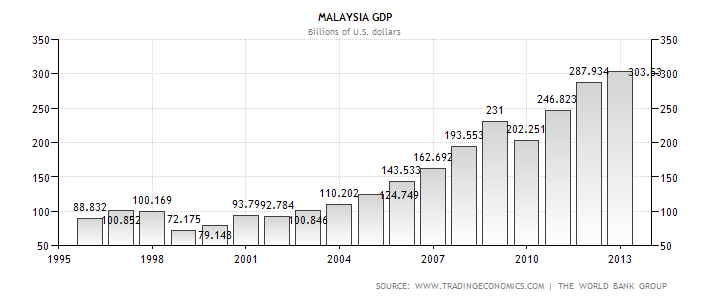
Since then, Malaysia embarked on an expansionary fiscal and monetary policy which led to an expansion of credit and also the proliferation public projects so as to extract its economy out of the recession. During the Asian Financial Crisis in 1999 Malaysia’s GDP per capita felled to $3653.83 compared to $4043.64 recorded in 1998. However since then as the expansionary policies worked its way into the economy, Malaysia’s GDP per capita risen as a result. This can be shown by the following graph on Malaysia’s GDP per capita since 1995.
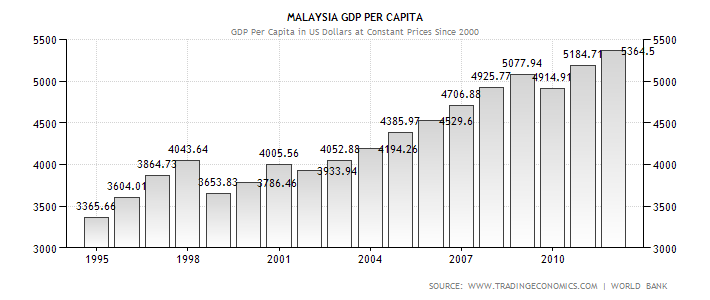
To encourage the private sector to spend, lending procedures are relaxed and interest rates are held low. As a result of the increases in both private and public expenditure, Malaysia’s GDP recorded a fourfold increase in 2012. In 1999, Malaysia’s GDP was valued at $72.175 billion and has since risen to $303.53 in 2012. This can be shown by the following chart.
However, the credit expansion brought about by our government earlier has led to a further increase in the household debt. As of 2010 Malaysia’s household to GDP debt has reached 78% where more than 55% of the loan concentration is in the mortgage market and 23% into the automotive market. And in 2012 the ratio went up to 83% which represents an increase of 13% from 2011.
Our next question is what contributed to our record Household Debt?
False Expectation of improved economic conditions brought about by our Government. We have mentioned many times in our previous articles that our Government has been painting a false picture on the real condition of our economy. With the aid of the media we are led to believed that our economy is growing at a healthy pace (GDP growth of 4.1%), our stock market is resilient, our housing market is healthy and sustainable (no bubble yet) due to the increasing rural to urban migration of the workforce and so on.
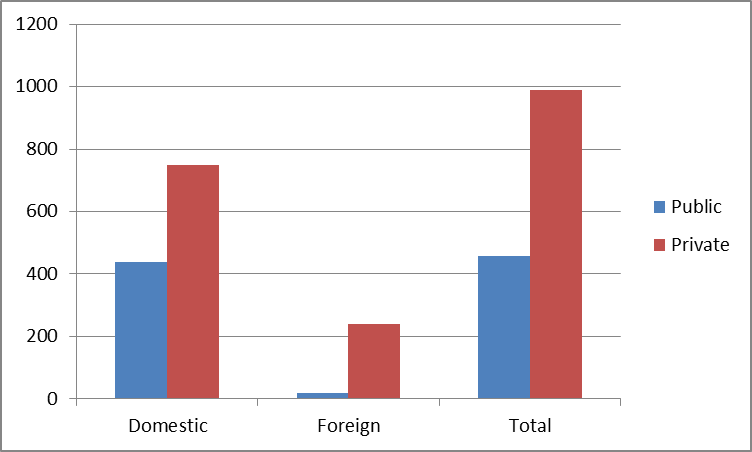
The easy availability of credit in the past and the lack of supervisory on the part of Bank Negara had led to an enormous build-up of the private sector debt. We shall present again the following chart which we have already mentioned in our last article titled ‘Is our GDP growth a Hoax?’
The following is the chart for the total debts by the private and Government sector as of 2011.
Debt
Domestic
Foreign
Total
Public
438
18
456
Private
749
239
988
Given the GDP of RM 860 billion we can then proceed to calculate the Debt/GDP ratio of both the public and private sector. The table below summarizes the ratio of domestic and foreign debts held by the public and private sector.
Debt
Domestic
Foreign
Total
Public
51%
2%
53%
Private
87%
28%
115%


From the above we can conclude that at the present moment the private sector poses a greater risk to financial default than the public sector. This is due to the fact that the private sector is much more exposed to any downside risk, arising not only from size of the debt (87%) but also its exposure to foreign debt (28%). Large exposure to foreign debt is risky because it is subjected to movements in foreign currency (US$ in this case) or external systemic market risk.
The movement of the US dollar creates currency risk or what we called ‘Foreign Exchange Exposure’ in Treasury terms. Foreign Exchange Exposure refers to the risk associated to a decline in a country’s currency. Currency depreciation can have the effect of reducing a company’s profits due to increased cost in imports or loss due to the higher repayments of loans denominated in US dollar.
How big a loss associated with currency movement depends on our Ringgit. On the negative node our country is currently running a ‘Twin Deficits’. Twin Deficits refers to a situation when we are having two economic problems at the same time (Budget Deficit + Balance of Trade Deficit). Twin deficits are known to create havoc in an economy by accelerating the decline of a country’s currency and in this case the Ringgit. So, obviously the risk of default in our private sector has certainly increased due to the problems coming in from multiple fronts.
A boom in the Housing and Stock Market. The boom in the housing and stock market for the past couple of years has increase the risk appetite of investors. Somehow they reckoned they have found a way to make money without putting much work. To them making money can be as easy as sitting in the stock market and pressing some buttons or flipping some real estates. Hence this led to many of them holding to a portfolio of 3 to 4 houses which risked being wipe-out should there be a serious downturn in the real estate market.
A strong response from the private sector especially from the business community to increase their exposure to debt due to the expectation of better times ahead.
Problem with ARMs Mortgage
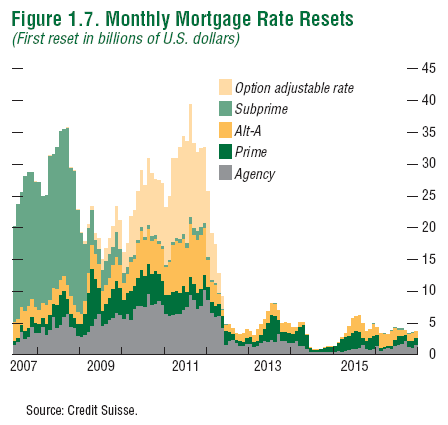
Another problem we are facing is that about 80% of the loans given to the housing market are in the ARMs (Adjustable Rate Mortgages) category which is also known as ‘teaser loan’ in the U.S. To lure prospective borrowers, banks offered very low initial repayments (such as BLR – 2 to 4%) during the first 3-5 years. Once that duration expires or resets then borrowers will have to start paying higher mortgages. That’s where the nightmare comes in.
For example, a RM 200,000 loan with tenure of 20 years, the initial repayment can be as low as RM 800 a month. When the 3-5 years period expires, the loan will be automatically resets to higher interest rates, probably (BLR + 0%) and repayment will be more than RM 1000 per month. One thing to remember is that ARMs is one of the major contributors to the U.S Housing meltdown. The following is the U.S Monthly Mortgage Rate Resets.
As can be seen above, the U.S housing crisis is yet to be over as the mortgage resets will continue beyond the year 2015. As for Malaysia our total housing loans has risen to MYR 222.2 billion from about MYR 25 billion in 1996.
Below is the chart for the housing loans to GDP as from 1996 to 2011.
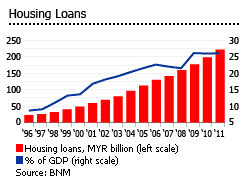
It shows that the outstanding housing loans has been on the rise since 1996 and reached MYR 222.2 billion in 2011 or around 26.1% of GDP, up 11.8% from a year earlier.
An oversupply of Housing?
According to C.H. Williams Talhar & Wong, there is an oversupply of high-end condominiums in Malaysia especially in Kuala Lumpur, Johor Bahru, Kota Kinabalu, Kuching and Penang. The following chart shows the relationship between the housing approval and oversupply.
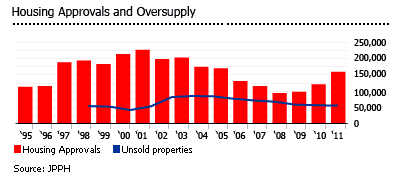
The over-supply of high-end condominiums remains a concern while a further 2,300 units of high-end condominiums will be completed in 2012, half located in the Kuala Lumpur City Centre (KLCC).
In total, around 54,557 properties were unsold at end-2011, down 2.3% on the previous year, and down 34.9% from the 2004 peak of 83,811 units. There was a 62.3% decline in house launches during the year to Q4 2011. It clearly shows that the housing market is already softening since the end of 2011. Moreover, we also received reports from real estate agents complaining that high-end properties (over MYR 1 million) are very sticky or difficult to sell.
Bank Negara Malaysia’s new measures
We are certainly living in interesting times. Fundamentally, our economy is weak. Our exports are plunging, our trade balances and deficits are negative and the only things that are going up are our companies bankruptcy that is on record territory, stock market, consumer spending, inflation, private and public debts. It seems like things are moving in opposite directions. Positive economic indicators are moving down while negative economic indicators such as inflation and household debts are moving up.
In view of our credit expansion problems, Bank Negara Malaysia (Central Bank of Malaysia) is implementing the following measures to curb the excessive debt incurred on the private sector namely the Household and Housing sector with immediate effect (06/07/2013).
> Reducing tenure of housing loans from 45 to 35 years
> Limiting tenure of personal loans to the maximum of 10 years.
> Prohibition of offering pre-approved personal financing products.
Before we address the effects of the above measures, we would like to digest what Bank Negara hoped to achieve with the above measures. In short, Bank Negara is trying to reduce the banking sector’s exposure to real estate and personal loans. In trying to do so, it is employing a strategy known as ‘shortening of maturities’. This can be literally translated in plain English as ‘the government is more concerned with short term instability than promoting long term growth’. In part, these measures we believe are also directed towards resolving our big budget deficits and Government Debt to GDP problem. Again these problems are due to our excesses in the past few years of credit expansion.
So how will the Government going to fix this problem? Our Government hoped that by reducing the credit, it will help reduce domestic consumption on consumer goods and real estate and at the same time try to expand the exports. This in time will helped reduce the trade balance due to the increase in exports and decrease in imports. By this our Government hoped to help built a sounder economy with a better income foundation and lesser debts.
However along the way a lot of people are going to get hurt due to the credit squeeze but there is no other choice if we want a transition to a better and more sustainable economy. Hopefully, more resources will be directed towards the more efficient part of the economy such as building more plants, better infrastructure, modernising production facilities or anything that can help the economy to make real products which can be used for domestic consumption or exports which will in turn earn foreign exchange. Our next question is will it work?
Will it work?
It appears that Bank Negara is definitely worried on the banking sector’s exposure to real estate. Any big downturn in real estate prices will definitely have profound effects on the economy. Among them are unemployment resulted from the construction related business and also the growth of NPLs in the banking sector. Below are the problems that may arise as a result of the latest measures.
Limitations to Monetary Policy – Long Lag
Central Banks have always been prudent in their approach towards the economy and that is the main problem. Sometime they waited too long before they act or when the problem is evidently long in its tooth. The slow response may be due to the problems associated with monetary policy implementation and they are the long-lag response and genie out of the bottle response. Monetary policy such as increasing the interest rate to counter inflationary pressure might take 6-9 months to work its way into the economy. If they waited until the inflationary effect is visible to us then it is already too late because the inflationary effect has already accelerated too much and the interest rate increase will have not much effect in contracting the economy.
Similarly to what is happening in Malaysia. Bank Negara should have taken action many months ago to stem the borrowing to the private sector and not waited until the problem becomes obvious. Now when they starting to take action, the genie is already out of the bottle and it is all but one hell of a difficult task to stuff the genie back into the bottle. The above measures will only have effects on new loans, how about the old ones?
Problem with our Shadow Banking System
This I would like to point out that as in many other countries we also have two different banking systems. One is called the formal banking where their operations are regulated by Bank Negara and the other one is the informal banking which is unregulated by Bank Negara. The informal banking system or Shadow Banking System consists of lending from private money lender and credit companies, inter-company loans, corporate bonds and loans by investment companies
Due to the current credit squeeze those who are unable to qualify for loans in the formal banks will turn to the informal banks. There are already a lot of evidence of individuals and SMEs and even developers are getting loans from the informal banks where maturities are short and interest rates are high. The problem is we do not know how large our informal banks are and what type of portfolios they are holding. Another problem is we do not know what sort of linkage or relationship between the formal and informal banks. If they are linked and if our real estate market were to collapse then the resulted decline in real estate prices will be serious, due to the following.
There will be force sales of real estate financed by the informal banks. This self-reinforce selling will further depress the prices of real estate. This is the last thing our Government wants because when the informal banks start to liquidate their assets to raise cash then it will cause further downward pressure on the market.
Informal banks may have got their funding from the formal banks. So any credit squeeze will certainly have effect on the operations of the informal banks which might force them to shorten the maturities, recall or totally freeze their loan operations.
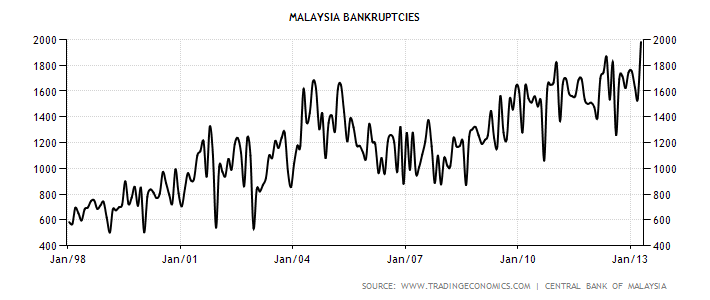
Without funds to finance their operations, many businesses may have to cease their operations. With the expected softening of the real estate market developers who have been snapping up land to build up their land banks will find it difficult to stay afloat. This can be shown with the following chart on bankruptcies in Malaysia from April 2011 to May 2013.
As from the two charts above, Malaysia recorded an increase in company bankruptcy. Total company bankruptcies reached a high of 1981 companies in April 2013. This is the highest ever number of bankruptcies recorded since January 1998. In view of the credit crunch we expect to see much more bankruptcies in the month ahead.
Hence, such risk is real and is already happening. Credit squeeze means there will be lack of funds available to individuals and companies and hence liquidity. Since liquidity is the lifeline of both the housing and stock market, a lack of it will definitely have profound effects on them. Lacked of liquidity will cause seizing up of transactions because of the negative expectations on the economy will make people and businesses lee willing to spend, which eventually will drive prices down. Even before the implementation of the credit squeeze the housing market has already shown signs of weakness.
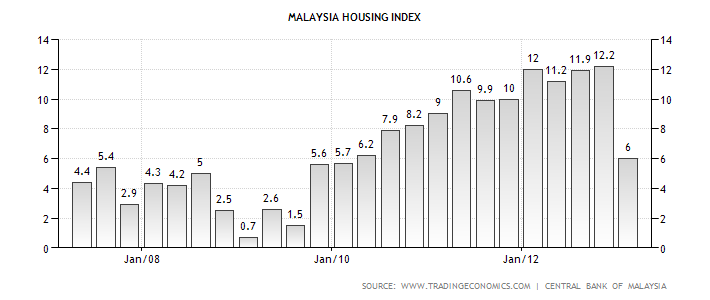
The Housing index refers to the residential construction activity during a period of time. As indicated by the housing index below, our residential construction activity has declined to 6% in the first quarter of 2013 from 12.2% recorded in the last quarter of 2012. It represents more than a 50% drop on a quarter to quarter basis. At 6% it brings us back to the level recorded in the early 2010 when our economy is just started to recover from the Global Financial Crisis in 2008. This big drop in housing activity certainly worries the authorities and which might be attributed to the over-leveraged consumers and also the peaking of the housing prices.
Housing prices in Tier-1 cities in Malaysia namely Kuala Lumpur, Penang and Johor Bahru has seen an unprecedented rise due to the easy availability of credit that resulted in a speculative frenzy. Any investment that is buoyed by easy credit especially housing and the stock market will eventually end up in a bubble. Despite numerous denials by our authorities the housing market in Malaysia has long been in a bubble.
As for the Stock Market we are saying it again. Sell and walk away. From the chart the market has been on the Distribution phase since 05/05/2013. We have drawn two lines that represent the distribution area and we will expect the market to breakdown from the lower line in the coming weeks. By then you will see an extremely volatile market.
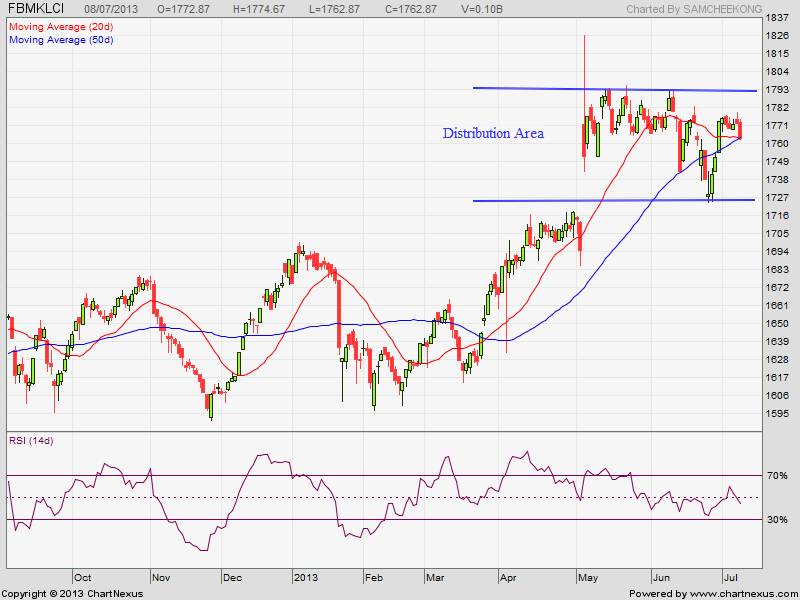
Due to the credit contraction we are expecting a continuation of decline into the next few months. Any rebound will be another bear trap and we are seeing a much lower index in the next few weeks and month. In short we are BEARISH!

Sunday, May 5, 2013

Warren Buffett's wisdom goes a long way

Warren Buffett offers advice on investing and life

  Billionaire Warren Buffett dispensed plenty of advice on investing and life during this weekend's Berkshire Hathaway shareholders meeting.

The wisdom Buffett and his investing partner Charlie Munger offer is part of what attracts more than 30,000 to the meetings each year.
Here's a sample of their insights:
INVESTING SUCCESS:
Buffett and Munger told shareholders that successful investors must learn all they can about the businesses they are buying and stick to industries they know, but the right temperament is also important.
"You just have to avoid getting excited when other people are excited," Buffett said.
Admittedly, it's hard to continue to make rational decisions about investments when the stock market is soaring, but it has proven profitable for Berkshire Hathaway.
"We've always tried to stay sane when other people like to go crazy," Munger said. "That's a competitive advantage."


The above appears in Yahoo news.on 6th May 2013
Must learn from him to be successful.

Friday, March 15, 2013

Next week at KLSE by Dr.Nazri


Bursa to continue downside next week


KUALA LUMPUR -- Bursa Malaysia is expected to continue its downside next week, dampened by the investors' wait-and-see attitude, profit-taking and traders' caution ahead of 13th general elections (GE13).

 Affin Investment Bank head of retail research, Dr Nazri Khan, said the local bourse, which was expected to touch the 1,620 level, however, will see moderate bargain hunting, especially among property and plantation counters.
 "Hence, we expect the local sentiment to be cautiously volatile, with alternating up and down FBM KLCI swings, ahead of the impending dissolution of parliament, which should be weeks away to pave the way for GE13. 
 "Further, the strength in the US dollar, softer ringgit and weaker commodities are another drags capping local equity upside," he told Bernama.
   Nazri said buying momentum and market breadth remained weak with the KLCI sliding 1.5 per cent from last week's high of 1664.39.
   He said based on historical trends, any downside and weakness weeks before GE were good buying opportunities. 
 "The FBM KLCI will generally soften before the general election, stabilise immediately after and hit a new high within three months after the election," hesaid.
   Although many investors were adopting a wait-and-see attitude currently,Nazri said, now was the best time to invest in quality local blue-chips. 
 "We expect most investors, especially foreign and high-end retail, to jumpback into the stock market immediately after the elections, pushing the local bourse higher in the early second half this year. 
 "We also see impressive strengths in our regional neighbours' stocks, which means Bursa Malaysia will play strong catch-up post-election," he said.
   Malaysia's better-than-expected fourth quarter 2012 gross domestic productgrowth and the expected resilient in the 2013 first quarter's earning resultsshould continue to support further upward revisions and higher stock price post-election, Nazri said.
 "Based on these resilient fundamentals, we are pegging 1,720 as our AffinInvestment Bank official target (post-GE) for the FBM KLCI by year-end which again means that now is an opportune time to accumulate stocks," he said.  - Bernama


Thursday, January 3, 2013

Important lessons to understand the stock market

Emotions can adversely influence our investment decisions and lead to irrational behaviour, according to a new study by Franklin Templeton Investments.
Many a time, one's emotional response is so instantaneous that one is unaware it is even occurring. And experts say a small little part of our brain called the amygdala may play a key role in our bad decisions.
It functions as the brain's early warning system, sending out messages of fear and anxiety to raise the alert of imminent trouble. This may cause us to regard negativity and pessimism as accurate.Understanding our emotional state and putting plans in place before emotions take over can help prevent poor investment decisions. The Franklin Templeton Investments report found five common mistakes made by investors, which can be easily avoided:

Loss aversion

This refers to the deep pain investors feel upon taking a loss and the lengths to which they will go to avoid that pain.
A study by psychologists Daniel Kahneman and Amos Tversky found that between a certain loss of US$3,000 (S$3,675), and an 80 per cent chance of losing US$4,000 and 20 per cent chance of losing nothing, more than 90 per cent of investors polled picked the latter, even though statistically it was the riskier proposition.
Since the global financial crisis- led market meltdown in 2008, many investors have been reluctant to buy equities out of loss aversion. They have preferred to remain in low-yielding vehicles that may deliver a negative real return after inflation.

Holding on to the past

Stock markets reflect the tendency of investors to anchor expectations to a given price. For example, a stock will typically trade for a while within a given range, then trend up or down to a new anchor level and trade within that new range.
Investors adjust expectations to the altered price, which is why overly sharp gains or losses provoke discomfort.
The sensitivity shown to price changes may be largely the result of memory for prices paid in the past, and not at all a reflection of true preferences or level of demand.

Following the crowd

A modern example of how the herd mentality can go seriously wrong is the dot.com phenomenon of 2000.
While the significance of the Internet was real and enduring, many of the companies into which investors poured their money were neither.
So, following the crowd can be a precursor to market bubbles, as what begins as a natural inclination to join in the growth path of a company can end in losses as the euphoria of explosive price increases causes investors to lose their sense of judgment.

Availability bias

Rather than analysing all the relevant information, investors tend to rely on whatever data is most recent or emotionally charged.
This can cause them to overreact to market conditions, whether positive or negative, or invest in a stock simply because it has been heavily covered by the media.

Mental accounting

Many investors practise mental accounting when they lock in certain assets for retirement, maintaining somewhat greater liquidity for controlled wealth accumulation, or allocating a smaller sum for high risk-high reward investments.
However, this compartmentalising means investors may also take unwarranted risks with their own money, or may be overly cautious with an inheritance.


Tuesday, December 25, 2012

The STAR most probably will shine again.

This counter Star (stock code 6084) is currently very weak. Will it shine again? Chances are good a profit will be made if we were to buy at RM 2.60 level.( My personal opinion only)

§  From a 3-month high of RM3.26 (19 sep), STAR tumbled 21% to a low of RM2.58 (24 Dec).
§  Values are likely to resurface after recent plunge and we see limited scope for further significant selldown due to its extremely oversold positions (daily RSI at 6.6 and slow stochastic at 1.8), defensiveness, strong netcash of RM230m as at 3Q12 (or 31sen/share) and attractive net dividends (6.9%). Valuation remains undemanding at 10.7x FTY13 P/E, implying a 11.5% discount to its 5-year average of 12.1x.
§  Immediate supports are RM2.54 (daily lower Bollinger band) and RM2.46 (23.6% FR). Lower supports are RM2.30-2.35. Risk takers may start to nibble as a relief rally in the pipeline with initial upside targets at RM2.72 (100-d SMA) and RM2.83 (20-d SMA). More formidable resistances are RM2.90 (50% FR) and RM3.05 (61.8% FR). Cut loss below RM2.43.

As Warren Buffett once said, be brave when you see blood in the street. There is no blood in the street yet but this particular counter (Star) has blood all over its price. So maybe it is good to buy some at around RM2.60 and sell when there is resonable profit to be made.